

Alexandria: The City That Changed The World

Review of Islam Issa's Book

The casting of the famous British-Jewish Hollywood actress Rachel Weisz as Hypatia of Alexandria in the 2009 movie Agora served as an inspiration for me to dig deeper into this ancient seat of power. In doing so, I came across this book, which changed my understanding of politics, power, and shifts in human civilization.
Islam Issa’s book on Alexandria is a league apart from conventional history books on empires, dynasties, figures, or events. What sets “Alexandria: The City that Changed the World” apart is that it forces the reader to focus on the rolling wheel of time through the lens of microscopic geography, influenced by the macroscopic waves of ideas, theology, revolution, geopolitics, and innovation. Through learning the history of Alexandria, the cosmopolitan city of the classical era and the shrine of world knowledge, readers get a glimpse of world history itself taking place on the stage of an ancient wonder.
Think of a city as a macrocosmic organism with a long life, evolving through architecture, urban design, and urban planning, and influencing the world through its own sense of identity and character. Islam Issa, an award-winning British-Egyptian author, broadcaster, curator, and professor of literature and history at Birmingham City University in the United Kingdom, is himself an Alexandrian narrating the tale of his city. He states the facts of antiquity with immense feeling and nostalgia, as if he witnessed the events himself. His style of writing is refreshing and deep. It took me back to my architectural thesis days in the Citadel of Gwalior when I was documenting the third-largest fortress of the ancient civilization of Bharatvarsh. Perhaps this is why my own artistic soul can deeply connect with Islam Issa’s passion for studying the city established by Alexander the Great.
As an architect, I always say that one can listen to the whispers of walls and the echoes of the past in royal chambers, clearly envisioning history playing out before one's eyes, if there is an "inner eye" for it. I sensed this same vision in Islam Issa’s narration. Cities are indeed living organisms, not merely physical architecture. They can influence one deeply; this may be why when Amr, the first Islamic conqueror of Egypt from the Rashidun Caliphate, arrived in Alexandria, he was seduced by the ancient beauty of the mythical past and towering structures. It made him feel as though he had time-traveled into the future. After all, Alexandria was home to one of the grandest ancient libraries in the world, with some figures estimating it held as many as 700,000 papyrus scrolls, until the destruction by the Christians 4th century AD.

The city was extremely crucial to both Christians and Muslims in establishing their faiths, as it held a reputation for being the knowledge center of the world. It would not be wrong to say that the "Islamic Golden Age", or what is claimed as the "Persian Golden Age" by Iranians, was built upon the foundations of knowledge emerging from Alexandria. The world’s first steam engine, created by Heron in the 1st century AD (predating the industrial steam engine invented in England in 1712), came from this very city while it was part of the Roman Empire. This establishes the fact that the Greco-Egyptian city of Alexandria, originally nurtured and developed by the Ptolemaic dynasty of Greek origin, peaked in terms of development and innovation during a time when later world powers like Great Britain, France, Germany, the USSR, the USA, and the Ottoman Empire were non-existent.
My inference from reading “The Golden Road” by British historian William Dalrymple is that there is a potential link between Alexandrian and Indian knowledge systems due to the trade between the Cheras and the Roman Empire. Moreover, Islam Issa mentions instances of Ptolemy II borrowing books from all over the world to enrich his dream library, including from India. Although these borrowed books were never returned to their original owners by the ambitious King, the investigation into the patenting of mathematical and scientific ideas is a topic I will discuss in a separate review of Dalrymple’s book.
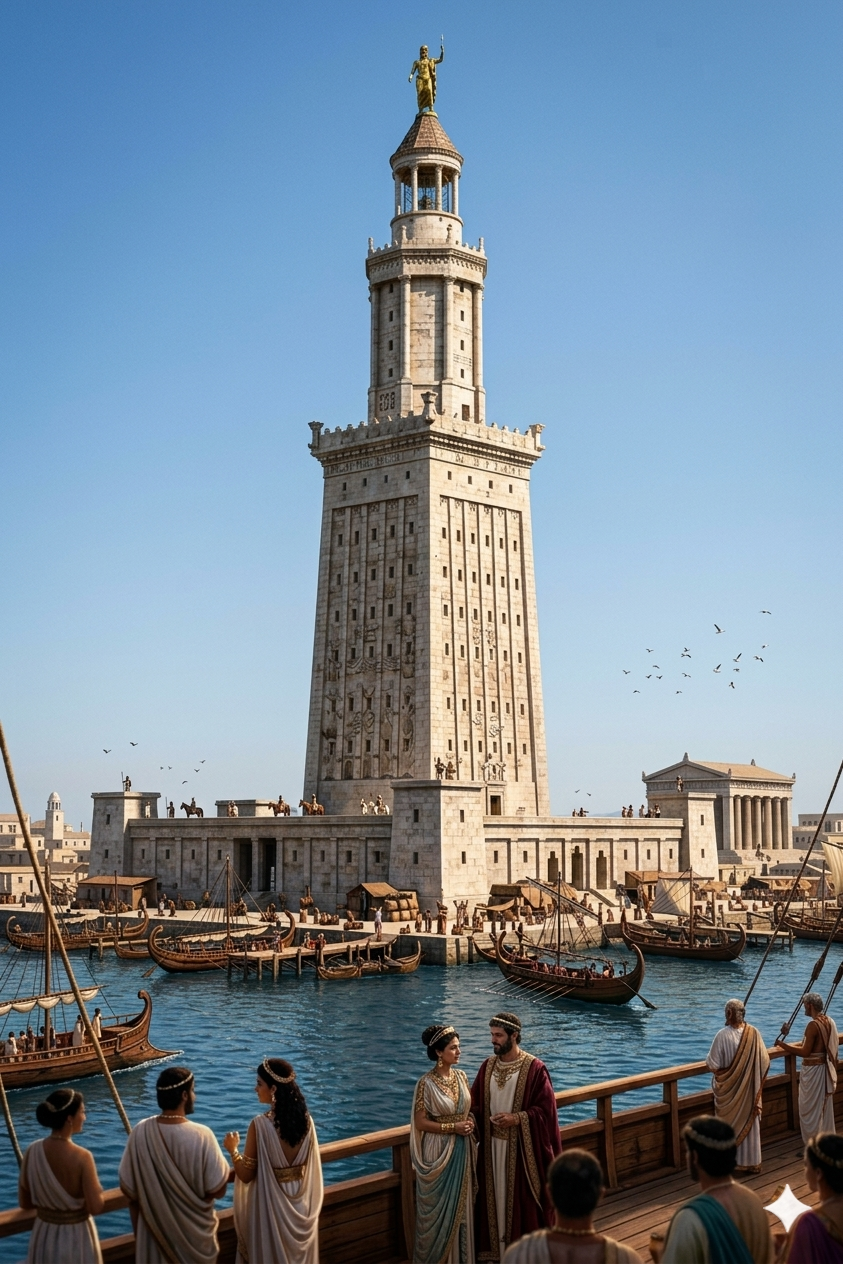
As an architect, I was personally drawn to the story of Alexandria for its legendary lighthouse. It was one of the largest man-made structures on Earth and the last of the ancient Seven Wonders of the World to disappear. The book describes its architectural magnificence beautifully, capturing the essence and ambience of the public areas of this marvel planned by the Greek urban planner and architect, Dinocrates.
As a student of history, architecture, and urban planning, I would like to quote an excerpt from this book that struck me:
“My city destroys itself and annihilates itself from instant to instant.”
It led me on a journey of thought regarding how similar this is to the story of the ancient city of Varanasi, or Kashi. Beyond the architectural aspects of the famous city of Alexander of Macedon or Queen Cleopatra VII, I resonated with this book on a spiritual level, as I craved to learn more about ancient Indo-European pagan culture and symbolism. While every page of this 476-page book was loaded with dense information that spurred my own personal research, the period of Hellenic and Egyptian religions fascinated me most of all.

I have often wondered why our traditions can feel so distinct in a world dominated by Abrahamic theology. Many of my deeper spiritual questions regarding incarnations, deification, and theories like dualism and non-dualism were addressed by learning the stories of Arsinoe II and Cleopatra VII. Their deification as the incarnations of Aphrodite and Isis made me realize how similar the ancient pagan worlds used to be. This is a discussion on the recurring patterns in Indo-European civilizations that I often explore elsewhere.

Islam Issa deserves appreciation for staying largely neutral and respectful throughout the book while covering sensitive topics like the Christian and Islamic conquests, the Jewish hub, the Druze faith, and the schisms within Christianity (such as Eastern Orthodoxy and Catholicism) and Islam (the Sunni and Shi’a contests for power).
Overall, the book is a perfect guide to how the world revolves around a static point of reference. This kind of research is more painstaking than writing a history of a single event or figure; stitching the narrative together to fill the gaps between different periods requires heavy research.
Alexandria is a city that will forever be associated with celebrated historical icons: Alexander the Great, Ptolemy Soter, Arsinoe II, Cleopatra VII, Julius Caesar, Mark Antony, Augustus, Mark the Evangelist, Caracalla, Pompey, Claudius Ptolemy, Hypatia, Saladin, Napoleon Bonaparte, Gamal Abdel Nasser, and Dodi Fayed.


I honestly can’t believe it’s already been 10 years since Anish and I met during our Bachelor of Architecture days. Back then, while the rest of us were trying to survive juries and submissions, he was probably already overanalyzing ancient civilizations and connecting architecture with philosophy. Reading this article genuinely felt like stepping back into our college conversations which were deep, intellectual, and somehow turning a single topic into an entire universe of ideas. His passion for history, architecture, and storytelling has always been unmatched, and this website perfectly reflects that. Proud of my friend for turning the same “Architect Brain” we saw in college into something this insightful and inspiring!
Your analysis was insightful and well-structured, you did a fine job of conveying both the book's scholarly depth and its accessibility to a broader audience.
Issa's exploration of Alexandria's multifaceted identity across millennia is not easy to distil, but your review managed to do so with clarity and precision.
Loved it. 🪷
Loved the clarity and depth in this review, such a well- articulated perpective